Month: November 2020

  • PC World: Apple is so full of it

    Gordon Mah Ung at PC World doesn’t believe Apple’s claims about the M1’s performance:

    Let me just say it outloud, OK? Apple is full of it. I’m referring to Apple’s claim that its fanless, Arm-based MacBook Air is “faster than 98 percent of PC laptops.” Yes, you read that correctly: Apple officials literally claimed that the new MacBook Air using Apple’s custom M1 chip is faster than 98 percent of all PC laptops sold this year.

    This is a totally reasonable point. After all, have Windows PCs running on ARM shown themselves as being stellar devices? Not so much.

    But we’ve had benchmarks for the A14 for a month now. The iPhone 12 and iPad Air definitely smoke the Surface Pro X. Why would a custom Mac chip be expected to be inferior to that?

    When Apple makes its claims, my guess is they are comparing the new M1 to Intel-based processors ranging from Atom to Celeron N to Core i3 and up, all with integrated graphics. But by not defining the word “performance,” all this becomes just pure marketing spin. And is it really fair to compare a $999 MacBook to one that costs $150? Because $150 PCs are included in the 98 percent of laptops sold.

    Apple’s claim likely included all of the lower powered Intel offerings. Of course, looking up benchmarks for Atom, Celeron N, and Core i3 show these to be no challenge for 2020 devices. The two year old A12 matches or exceeds their performance, especially in single-core. But what about the beefier options?

    Does that mean the new fanless MacBook Air is faster than, say, Asus’ stupidly fast Ryzen 4000 based, GeForce RTX 2060-based Zephyrus G14? Does it mean the MacBook Air is faster than Alienware’s updated Area 51M?
    The answer, I’m going to guess is “no.” Not at all. Is it faster than the miniLED-based MSI Creator 17? Probably not, either.

    The implication here is that Apple can out-perform the low powered Intel offerings but is far behind the powerful Windows laptops. “Could a fanless Mac with a low power chip truly be faster than these higher power, cooled systems?”

    I tried to look up each of these and compare benchmarks.
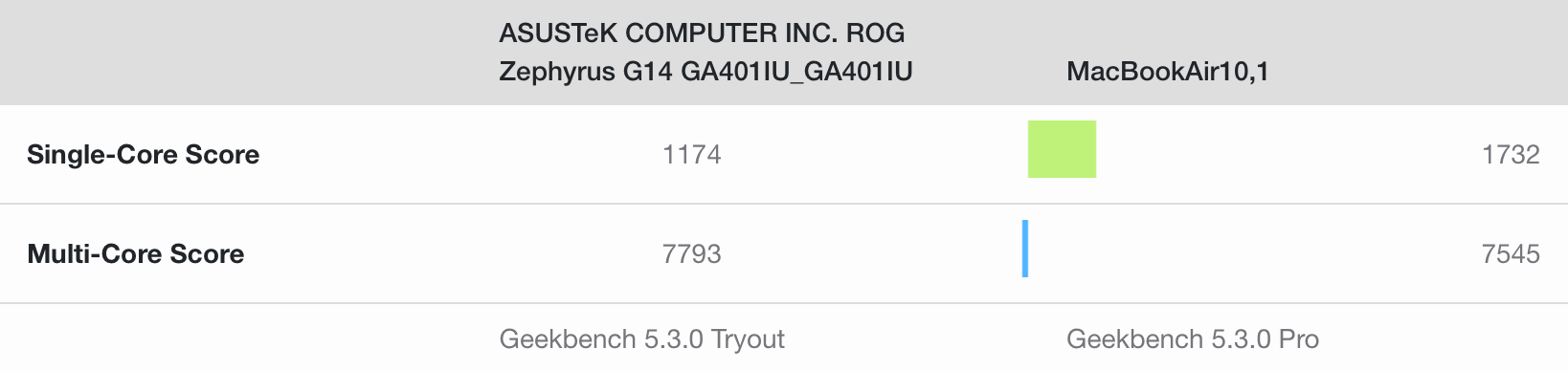
    Zephyrus G14 vs 2020 MacBook Air

    Against the Zephyrus G14, the M1 blows it away in single-core performance. In terms of multi-core, it’s about even, with the M1 barely behind. The G14 is “stupidly fast”, he says? Guess that means the new MacBook Air and M1 are “stupidly fast”, too.

    Area 51M vs 2020 MacBook Air

    For this comparison, I used the 10-core option of the Area 51M. That seemed to give it a more substantial lead over the M1 in multi-core. Again, in single-core performance, the M1 takes the lead. And while not as fast in multi-core, I think it’s fair to again point out that the M1 is doing this in a fanless design starting at $999. Meanwhile, the Area 51M R2 is marketed as having “advanced cooling” and, for the 10-core model from Dell, can be purchased for $3,700. Did the Alienware win this one? I’d say it barely did, but at almost 4 times the cost. That’s telling.
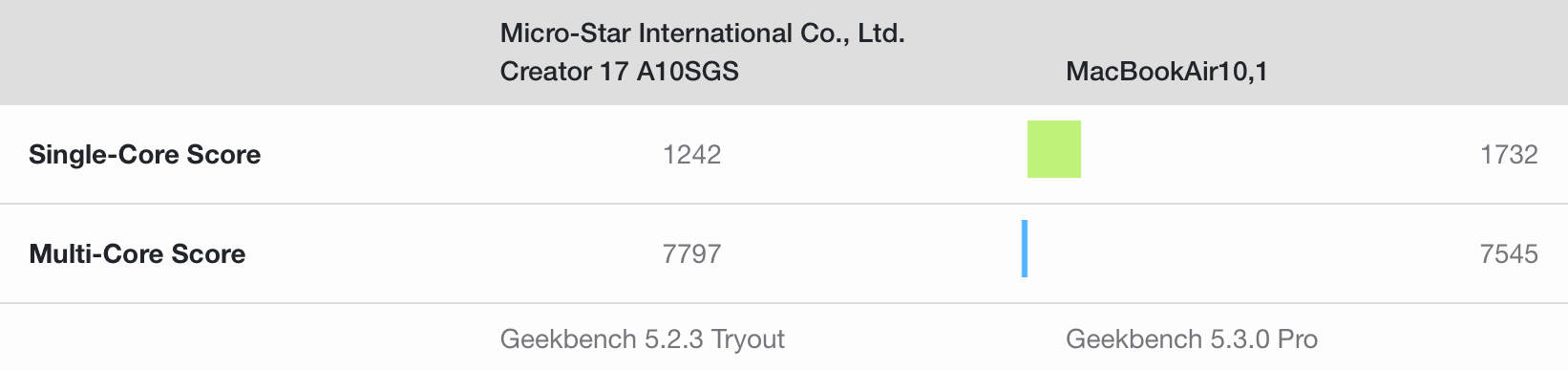
    MSI Creator 17 vs 2020 MacBook Air

    The Creator 17 looks more like the G14. M1 wins single-core again. Multi-core is close. If you think the MSI Creator 17 is a fast machine, then again, the MacBook Air and M1 are going to easily match or outpace this (depending on whether your operations rely on single or multi core performance). And, like the Area 51M R2, the Creator 17 has a 3-fan design and starts at a more reasonable price of $1499.

    So, is the M1 faster than 98% of laptops sold in the last 12 months? If it can closely match (or, in single-core, crush) these ‘top 3’ options, it likely is faster than any Intel offering with a lesser CPU. In which case, it’s not just marketing spin: Apple is telling the truth about the performance of the M1.

    And this is all in a fanless design (it specs similarly in the Mac mini and 13-inch MacBook Pro, both which have a fan). When Apple starts churning out chips for the larger MacBook Pro, iMacs, or eventually the Mac Pro, these are going to embarrass the rest of Intel’s line.

    Meanwhile, I don’t think that PC World article is going to age well.
  • AnandTech’s Look at the A14, and the Implications for Mac

    While today was all about Macs with Apple Silicon, the M1 chip in those Macs is likely based on the A14. AnandTech today dove into the A14, found in the iPhone 12 and latest iPad Air:

    In the overall mobile comparison, we can see that the new A14 has made robust progress in terms of increasing performance over the A13. Compared to the competition, Apple is well ahead of the pack – we’ll have to wait for next year’s Cortex-X1 devices to see the gap narrow again.

    What’s also very important to note here is that Apple has achieved this all whilst remaining flat, or even lowering the power consumption of the new chip, notably reducing energy consumption for the same workloads.

    One further note is the data of the A14’s small efficiency cores. This generation we saw a large microarchitectural boost on the part of these new cores which are now seeing 35% better performance versus last year’s A13 efficiency cores – all while further reducing energy consumption. I don’t know how the small cores will come into play on Apple’s “Apple Silicon” Mac designs, but they’re certainly still very performant and extremely efficient compared to other current contemporary Arm designs.

    Apple chip team continues to lead. Increased performance without increasing power consumption is no small feat. And again, this is looking at the A14 in the iPhone 12. The M1 chip in the new Macs no doubt build on this, which is why those Macs can claim such performance increases while reporting almost double the battery life for operations with previous generation Macs.

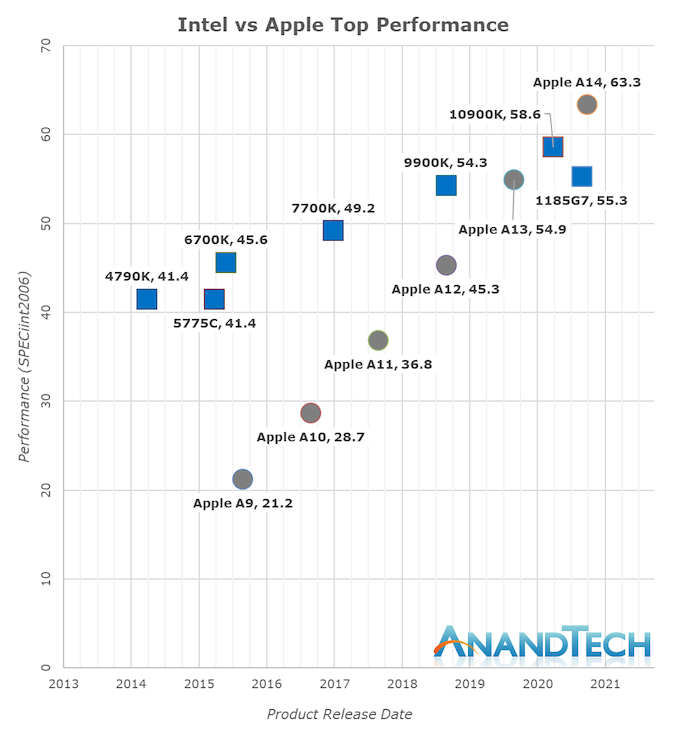
    The performance numbers of the A14 on this chart is relatively mind-blogging. If I were to release this data with the label of the A14 hidden, one would guess that the data-points came from some other x86 SKU from either AMD or Intel. The fact that the A14 currently competes with the very best top-performance designs that the x86 vendors have on the market today is just an astonishing feat.

    In the overall SPEC2006 chart, the A14 is performing absolutely fantastic, taking the lead in absolute performance only falling short of AMD’s recent Ryzen 5000 series.

    The fact that Apple is able to achieve this in a total device power consumption of 5W including the SoC, DRAM, and regulators, versus +21W (1185G7) and 49W (5950X) package power figures, without DRAM or regulation, is absolutely mind-blowing.

    One thing I love with AnandTech are their charts. Their benchmarks of the A14 against typical PC silicon are amazing to see. And Apple is doing that with a chip that uses a fraction of the power. If Apple were to scale their designs into something that did use 20+ Watts, you can imagine how it would handle such benchmarks.

    Performance improvements, Apple in gray, Intel in blue. It’s no surprise that Apple chose this time to move Macs to their own silicon

    Whilst in the past 5 years Intel has managed to increase their best single-thread performance by about 28%, Apple has managed to improve their designs by 198%, or 2.98x (let’s call it 3x) the performance of the Apple A9 of late 2015.

    Apple’s performance trajectory and unquestioned execution over these years is what has made Apple Silicon a reality today. Anybody looking at the absurdness of that graph will realise that there simply was no other choice but for Apple to ditch Intel and x86 in favour of their own in-house microarchitecture – staying par for the course would have meant stagnation and worse consumer products.

    Today’s announcements only covered Apple’s laptop-class Apple Silicon, whilst we don’t know the details at time of writing as to what Apple will be presenting, Apple’s enormous power efficiency advantage means that the new chip will be able to offer either vastly increased battery life, and/or, vastly increased performance, compared to the current Intel MacBook line-up.

    Apple has claimed that they will completely transition their whole consumer line-up to Apple Silicon within two years, which is an indicator that we’ll be seeing a high-TDP many-core design to power a future Mac Pro. If the company is able to continue on their current performance trajectory, it will look extremely impressive.

    The future of the Mac is exciting.

    Apple claims the M1 to be the fastest CPU in the world. Given our data on the A14, beating all of Intel’s designs, and just falling short of AMD’s newest 5950X Zen3 – a higher clocked Firestorm above 3GHz, the 50% larger L2 cache, and an unleashed TDP, we can certainly believe Apple and the M1 to be able to achieve that claim.